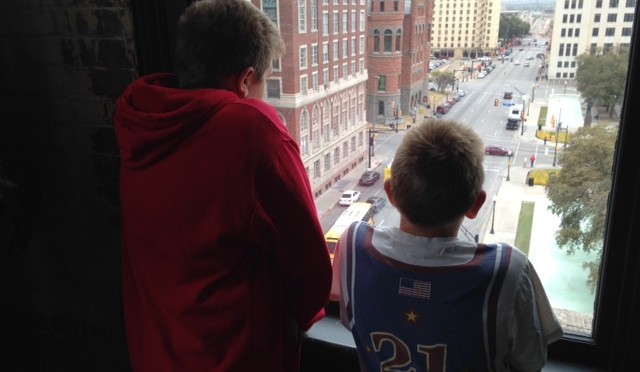
I paid a pilgrimage yesterday, to the sixth floor of the Texas School Book Depository. And to Dealey Plaza visible out its windows.
Everything’s been said about November 22, 1963. And still so many questions linger. I looked for something new, for me, and found it. In listening to the inventory of items found at the window, I heard, for the first time, something I’ve probably heard a hundred times before: “…a partially consumed lunch.” Let’s see…maybe eat half my liverwurst and cheese, set up the boxes in the window…” If I live to be a hundred, so many elements of that day won’t compute.
Suffice to say if and when I ever make it to heaven, one of my first five questions will be, “…about Dallas, 1963….” and judging by the respectful crowd on a Tuesday morning in March 2014, I won’t be the only one.
As I walked the solemn exhibits, I wondered if the seniors around me in the museum were split as I was, so viscerally between the present and the past. I have never been so emotionally impacted by a place before, and at my age, I have seen a lot of places.
I know how arrogant this next part will sound, but it’s the truth. I had to come to the museum to make sure they got it right. It is one thing to study history–the noble and the shameful elements that make up our today.
But Dallas is my history. Just like millions of others my age and older, it happened to me. I know that because images of those four days are poised in the wings of my mind, clear and young and indelible. I lived it and live it. And so I wanted to be sure they got it right. For myself, and for my kids, about which 1963 is to them what World War I was for me: a chapter in a book.
Amazingly, they did get it right.
No display calls attention to the fact that Jack Kennedy was no saint. The exhibit is a shameless tribute to the man. But it avoids the temptation to sidestep the host of questions that linger about the many factions that both revered and reviled Kennedy, and how one young, career loser leans forward at the end of a chain of dark coincidences to set aside his sandwich and obliterate Camelot.
A man may die, nations may rise and fall, but an idea lives on.
John F. Kennedy
February 8, 1963