We rolled down into the Valley of the Sun over the Mogollon Rim out of Payson, one of the more spectacular routes to enter the Phoenix area. The mountains to the northeast of Phoenix are mantled in pine forests in cool, crisp air that is the opposite extreme from Phoenix itself.  Which is why Phoenicians escape to Payson, Christopher Creek, and points north and east in the broil of summer.
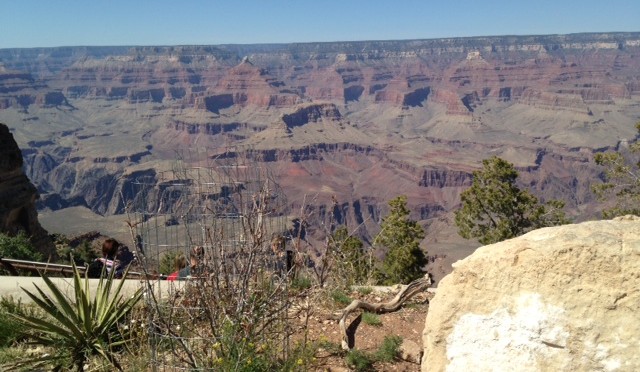
On our anniversary, we drove up through Flagstaff from our campground in Apache Junction, to join the large mid-week crowd on the south rim of the Grand Canyon. We originally planned to hit the north rim on our way back from San Diego to Maryland several weeks from now,  but then learned that not only were dogs not allowed, but the north rim isn’t even open until May 15!
At the South Rim, we picked up a morbidly fascinating book entitled “Over the Edge: Death in Grand Canyon,” which details the various ways loads of humans have died at this national park. If you’ve been, you can perhaps appreciate the feeling that you need to go either for an hour or a month. In the first instance, you can say you were there. In the second, you can experience the full majesty of the place. Or at least a tiny slice of it.
As I talked to my cousin Jason about the disorienting experience of standing on the edge of a precipice so high that perspective is hopeless, he reminded me that the tourist planes and helicopters, which seemed like tiny birds in the deep immensity of the Canyon, no longer fly into the gigantic abyss. Without those objects to lend perspective, it is easier to see how some poor souls who have simply dared to stand at the edge with no guard rail, the next moment plunged inexplicably hundreds of feet to a messy but instant demise.
The canyon also demands time, I think, because it becomes more compelling in my memory as you step below the rim on one of the trails and begin to descend. And it becomes more magnetic, siren-like, the further you go.
In that sense, canyoneering is completely opposite mountaineering. When you climb, all the hard work is in the first half, and what you can mount, you are reasonably sure you can descend. The Canyon, though, saves its greatest challenge for your return to the surface–the only area that the vast throngs of visitors ever experience.
The book also documents the erroneous belief that for a generation or two raised on Disney and innumerable man-made attractions, surely if you get in trouble in a National Park, someone will stop the ride long enough to rescue you.
If you plan a trip to the Canyon, or just enjoy the great outdoors, consider reading Over the Edge... it is an object lesson on nature’s promise that while stunning, the natural world also proves that what can go wrong will go wrong. At the worst possible time.
Whew! Fantastic opening shot! These kids are getting an education. Thanks.
Love the videos!